The photos of the lot are informative and indicative, and cannot provide a highly detailed view of the object from all angles. We recommend a careful physical inspection of the lot before bidding.
Exhibition catalogue "Arthur Segal. 1875-1944. A Selection of Paintings", April 2 - 14, 1973, The Alpine Club, London.
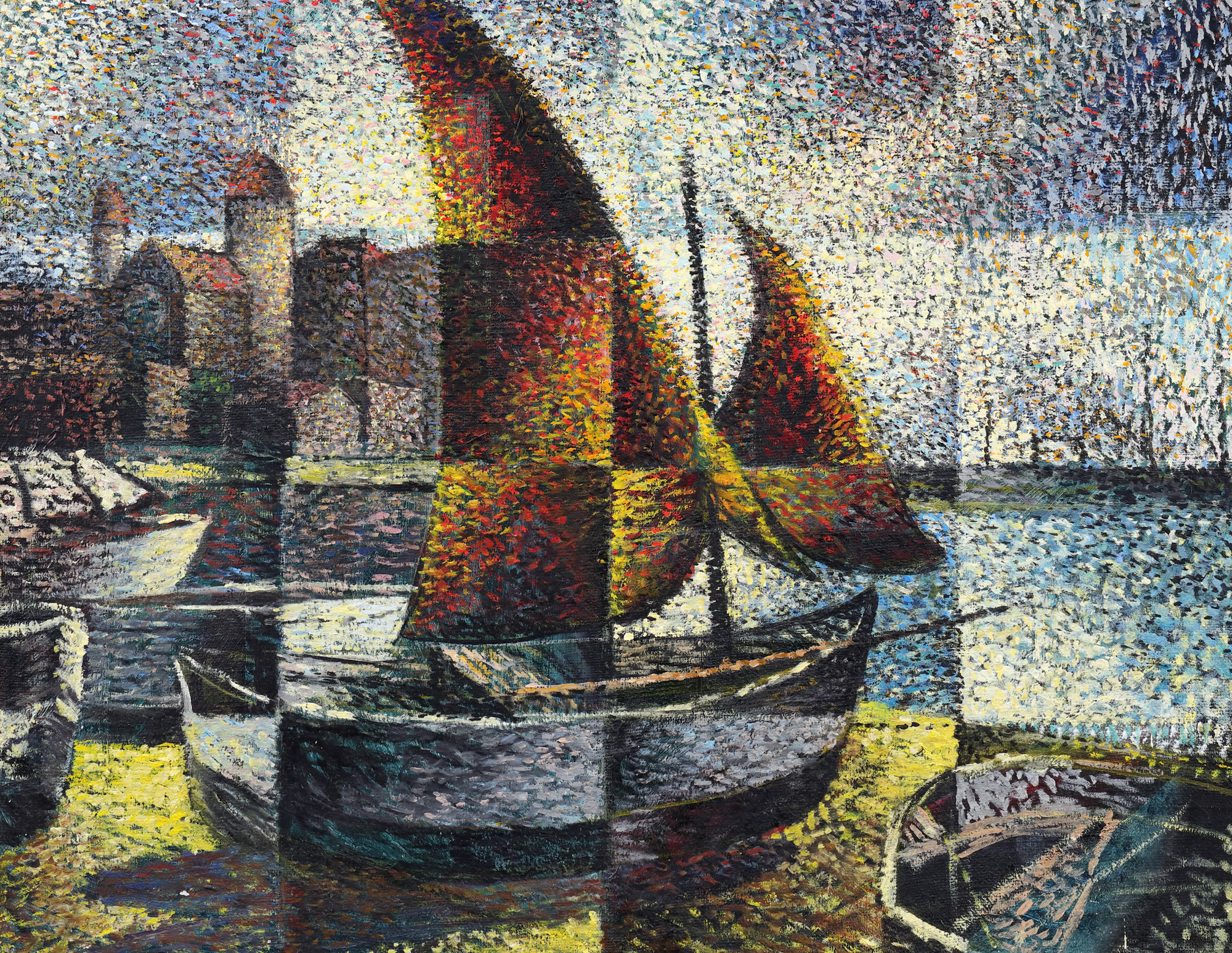
oil on canvas, 72 x 90.5 cm, signed and dated bottom left, in black, "A. Segal, (19)44"
Research information
The artwork participated in: the commemorative exhibition "Arthur Segal", The Royal Society of British Artists Galleries, London, 1945, cat. 297, under the title "Boote".
The work is reproduced in the album "Arthur Segal: Painter and Work", Hermann Exner, Dresden, 1985, no. 14.
The work is also reproduced and inventoried in the catalogue raisonné "Arthur Segal 1875-1944", Pavel Liska and Wulf Herzogenrath, Argon Verlag, Berlin, 1987 at cat. no. 720, pg. 372.
Arthur Segal was more likely an adept of the modern currents, with international reputation; so it often happens that his image is not associated, in collective memory, with our native space. After a short journey through the art education institutions in Munich, Paris or Italy, Segal's creation will undergo style permutations, visibly influenced by the spaces and currents encountered by the artist in his wanderings. Therefore, there will be visible leaps from impressionism and neo-impressionism, to expressionism and Dadaism, for the artist to finally define his own modern style. After completing his studies, he settles in Berlin, where he will contribute to the founding of the Neue Secession group. In 1914 he arrives in Zurich, the nucleus of the avant-garde movement at that time, and meets the artists Jawlensky and Arp, with whom he will create under the auspices of the Dadaist current and will exhibit at the Cabaret Voltaire. In 1920 he returns to Berlin, where he opens a personal exhibition and joins the board of directors of the Novembergruppe movement, with whom he will exhibit until 1932. He will live for a while in Mallorca, Spain; but will settle, starting from 1936 and until the end of his life, in London. The first period of his creation will unfold under the influence of Segantini, Van Gogh or Matisse (until 1916). The move to Ascona, Switzerland, brings the discovery of the expressionist manner, which will lead the artist towards the desire to conceive his art based on harmony and balance. In 1923, Segal learns about the color theory proposed by Goethe and returns to some works made in his neo-impressionist period, before 1916. In Romania, Arthur Segal is perceived as the father of the Israeli avant-garde scene. Through the filiation of religious affiliation he will take part in an exhibition dedicated to "Jewish Artists of Our Times", alongside Marc Chagall, Erlich, Kisling, Lipschitz or Modigliani. And as a representative of abstract art, he will exhibit along with artists such as Braque, Kandisnky, Klee, Mondrian or Picasso, at Mannheim. By the mid-'40s his style had already undergone several permutations and had reached a point marked by a deep geometrism. The present work, tribute to the mentioned period, reveals to us a geometric marine motif, with interchangeable accents of chromatic delimitations. Shades of gray in various declensions predominate, but also red, yellow or orange. The boat and sails, the sea and sky, the shore and buildings are rendered in pronounced pointillist touches. Made in the last year of his life, the work was presented to the public in the following year, at the commemorative exhibition dedicated to the artist at "The Royal Society of British Artist Galleries", London. The work also appears reproduced in several monographs dedicated to the artist.
For clarifications regarding the bidding procedure, hammer price costs, guarantee, payment, and collection terms for the winning lot, we recommend carefully reading/re-reading the Bidding Regulations.
For additional information regarding the lot and the auction, please contact the Art Consultants Department.
By choosing "Accept all cookies" you agree to the use of cookies to help us provide you with a better user experience and to analyse website usage. By clicking "Adjust your preferences" you can choose which cookies to allow. Only the essential cookies are necessary for the proper functioning of our website and cannot be refused
Cookie settings
Our website stores four types of cookies. At any time you can choose which cookies you accept and which you refuse. You can read more about what cookies are and what types of cookies we store in our Confidentiality Policy.
are necessary for technical reasons. Without them, this website may not function properly.
are necessary for specific functionality on the website. Without them, some features may be disabled.
allow us to analyse website use and to improve the visitor's experience.
allow us to personalise your experience and to send you relevant content and offers, on this website and other websites.